
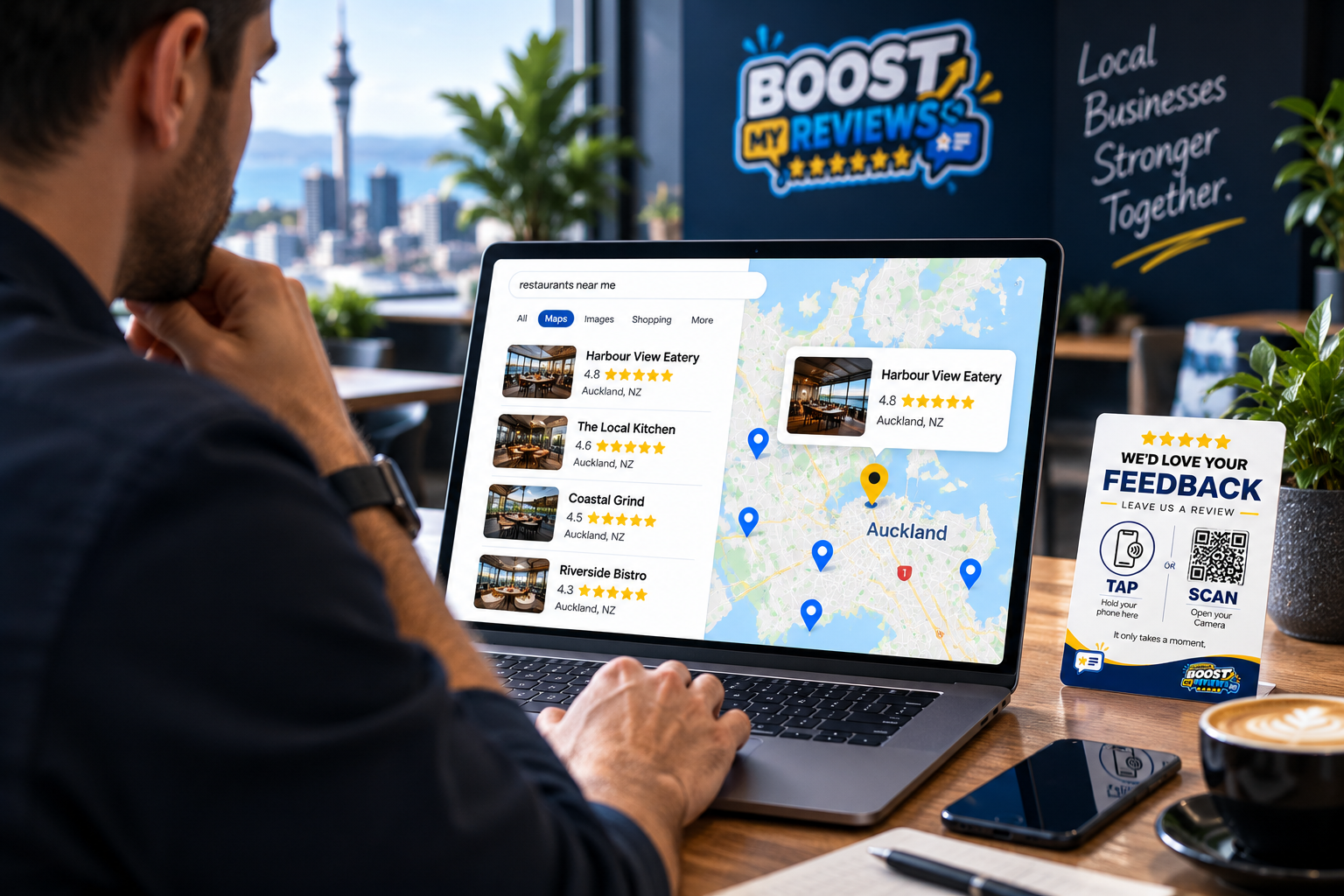
When somebody searches for a nearby restaurant, plumber, dentist or retailer, Google Maps can influence which business they contact first. Being visible in those local results is therefore important—but there is no switch that instantly places a business at the top.
Google says local results are mainly based on relevance, distance and prominence. You cannot control where every customer searches from, but you can help Google understand your business, build genuine local trust and measure how your visibility changes across the areas you serve.
1. Understand how Google chooses local results
Local search results are personal to the searcher. Two people searching for the same service from different Auckland suburbs may see a different order because distance is part of the calculation.
Relevance is how closely your Business Profile matches the search. Distance considers how far the business is from the searcher. Prominence reflects how well known the business appears online and offline, including signals such as links, reviews and ratings. That is why local visibility needs more than one tactic.
- Relevance: clearly describe what the business offers
- Distance: results can change from one suburb or street to another
- Prominence: build a credible, well-reviewed local presence over time
2. Verify and complete your Google Business Profile
Start with the fundamentals. Verify the profile and make sure the business name, primary category, address or service area, phone number, website and opening hours are accurate. Add special hours before public holidays and keep temporary closures current.
Complete information helps Google match the profile to relevant searches and prevents customers from arriving when you are closed or calling an old number. Use the real-world business name rather than adding extra keywords that are not part of it.
- Use the most accurate primary business category
- Add relevant secondary categories without overloading the profile
- List core services or products in plain language
- Keep standard and special opening hours current
- Check that the website and phone number work on mobile
3. Make your services and location clear
Your profile and website should make it easy to understand what you do and where you do it. A vague profile makes it harder for customers—and search systems—to connect the business with a specific need.
Create useful website pages for major services and genuine locations. A New Zealand-wide statement is not a substitute for clear information about the suburbs, towns or regions you actually serve. Avoid creating thin pages that repeat the same text with only the place name changed.
- Describe each important service accurately
- Use New Zealand terminology your customers actually use
- Include a genuine address or service area where appropriate
- Keep business details consistent across your website and reputable directories
4. Earn a steady flow of genuine customer reviews
Reviews help potential customers understand recent experiences with your business. Google also states that more reviews and positive ratings can support local ranking, although reviews are only one part of the wider picture.
Ask every eligible customer consistently after the service, purchase or appointment. Make the process simple with a direct link, QR code, NFC product, email or SMS. Never offer a discount, gift or prize in exchange for a review, and do not ask only customers you expect will leave a positive rating.
- Ask while the customer experience is still fresh
- Link directly to the correct review destination
- Use one polite reminder rather than repeated messages
- Invite honest feedback instead of asking for five stars
- Monitor review activity across every business location
5. Reply to reviews like a real local business
Responding shows that customer feedback reaches a real person. Thank customers for positive feedback, refer to something specific they mentioned and keep the reply conversational rather than promotional.
For a negative review, stay calm, protect the customer’s privacy and offer a practical way to continue the conversation by phone or email. Consistent, helpful replies build confidence for the future customers reading them.
6. Add useful, current photographs
Good photographs help customers recognise the business and understand what to expect. Add clear images of the storefront, team, completed work, products and customer areas where appropriate.
Use recent, truthful images rather than generic stock photographs. For multi-location businesses, each profile should represent that specific location. Photos support conversion even when they do not produce an immediate ranking change.
7. Measure visibility from more than one point on the map
Searching your own business name from one phone does not provide a reliable view of local performance. Results can be influenced by search location, wording and personal context.
A Local Search Grid checks the same keyword from multiple points around an area. This can reveal where the business is visible, where competitors are stronger and whether improvements are concentrated around the premises or spreading across the wider service area.
- Track a small group of commercially important search terms
- Use the same map area and grid settings for fair comparisons
- Compare changes over weeks and months—not hour by hour
- Review each location separately in a multi-location business
- Connect visibility changes with profile updates, reviews and website work
8. Follow a simple 30-day local visibility plan
Local SEO improves through consistent maintenance rather than one large update. Use this four-week plan to create a manageable starting rhythm.
- Week 1: audit profile details, categories, hours, services and links
- Week 2: add current photographs and improve important service pages
- Week 3: begin a consistent, policy-compliant review request process
- Week 4: measure a Local Search Grid baseline and review competitor visibility
What to avoid
Be cautious of anyone promising a guaranteed number-one position. Google says there is no way to request or pay for a better local ranking, and the distance between a searcher and a business will always affect some results.
Avoid keyword-stuffing the business name, buying reviews, creating misleading locations or making several major changes without recording them. Sustainable visibility comes from accurate information, genuine customer experience and evidence-led improvement.
Improve the signals you can control: accurate profile information, clear services, genuine reviews, helpful replies, strong local website content and consistent measurement. Track visibility across the actual areas your customers search from, then improve one weakness at a time.
Official resources
These primary sources provide further guidance: