
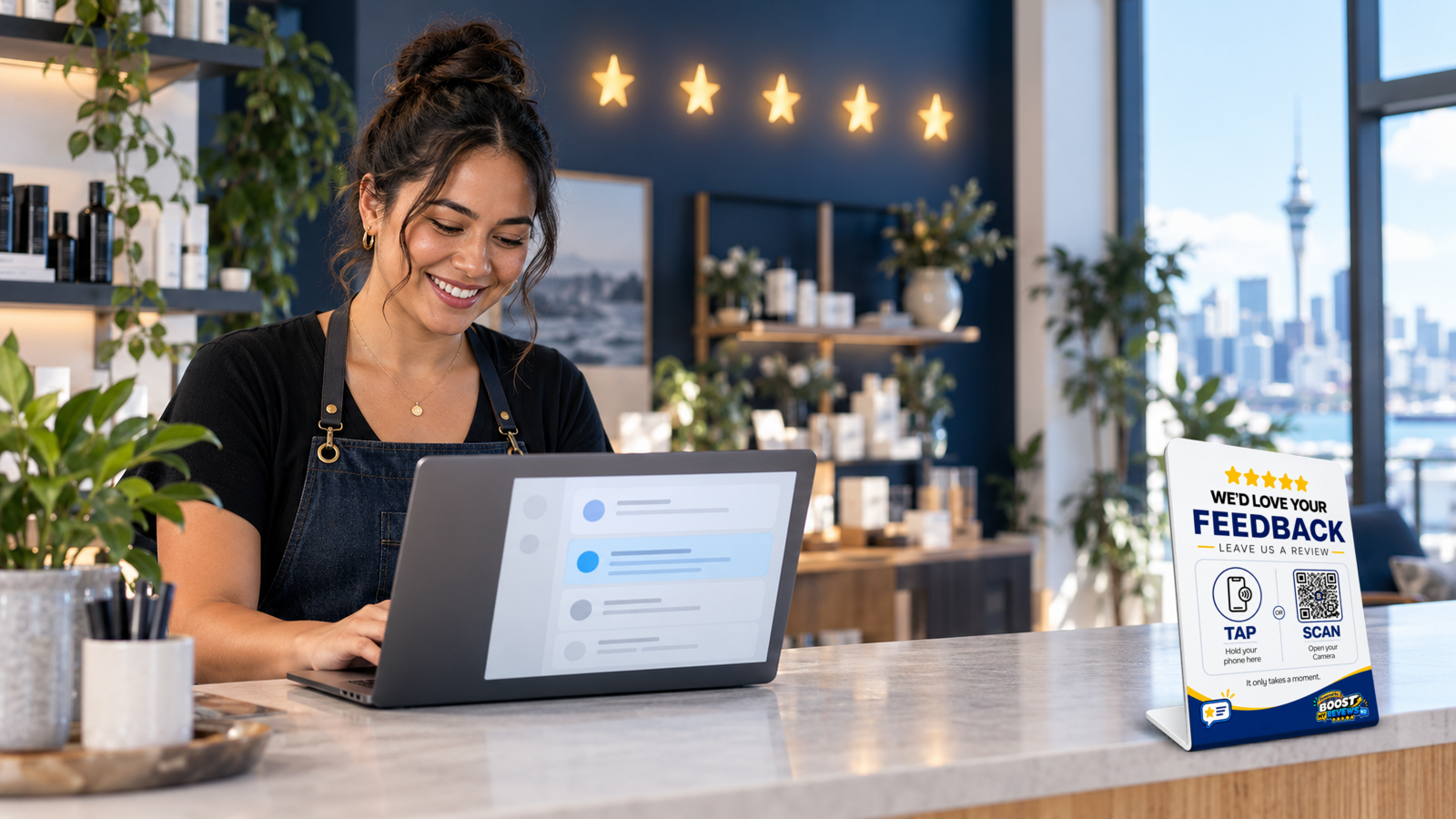
Positive reviews are easy to appreciate and surprisingly easy to answer poorly. A quick ‘Thanks!’ acknowledges the customer, but it misses the chance to recognise what they valued and show future readers how your business communicates.
Learning how to respond to positive reviews does not mean writing a long message under every comment. The best replies are warm, specific and proportionate. They sound like your business, not a copied template, and they never make promises the review does not support.
Why a thoughtful positive-review reply matters
A review reply is visible customer service. It speaks to the reviewer, but it is also read by people comparing businesses later. Google advises businesses to reply professionally, keep responses clear and helpful, and show customers that their feedback matters.
A thoughtful response closes the loop. It thanks the customer for taking the time, confirms that the team noticed the detail they shared and reinforces the experience the business aims to provide.
The goal is not to turn every reply into an advertisement. Keep the customer at the centre. A brief, genuine response is stronger than a paragraph filled with services, keywords and sales claims.
- The reviewer feels heard rather than processed
- Future customers can see an active, attentive business
- Staff can recognise the behaviours customers value
- The brand voice stays consistent across locations and team members
- Specific replies avoid the appearance of copy-and-paste automation
Use the thank, personalise, reinforce, invite framework
A reliable reply can be built in four short moves. You will not need all four every time, but the order keeps the response focused on the customer.
- Thank: acknowledge the customer’s time and feedback
- Personalise: use their name when appropriate and mention one genuine detail from the review
- Reinforce: connect that detail to the service standard or team behaviour you value
- Invite: close naturally with a low-pressure welcome to return, contact the team or visit again
A simple positive review response example
Imagine a customer praises quick communication and a tidy installation. A useful response could be: ‘Thanks, Anna. We’re pleased the communication was clear and the installation was completed neatly. The team will appreciate your feedback, and we’ll be happy to help again whenever you need us.’
The reply thanks the customer, reflects the details they mentioned, recognises the team and closes without turning the message into a sales pitch. It is specific enough to feel personal while staying short.
Positive review response examples by industry
Use these examples as adaptable patterns. Replace the detail with something the customer actually mentioned, and remove any sentence that is not true for the interaction.
| Business | Example response |
|---|---|
| Café | “Thanks, Mia. We’re so pleased you enjoyed the coffee and the friendly service this morning. We’ll pass your kind words to the team and look forward to welcoming you back.” |
| Salon | “Thank you, Priya. It’s lovely to hear that you felt listened to and were happy with the final style. We’ll make sure Sam sees your feedback. We look forward to seeing you next time.” |
| Tradie | “Thanks, James. We appreciate you mentioning the clear communication and tidy workmanship. That is exactly the standard our team aims for. Please get in touch if we can help again.” |
| Hotel | “Thank you, Sophie. We’re delighted the room was comfortable and our reception team made check-in easy. We’ll share your comments with them and hope to welcome you back to Auckland.” |
| Professional services | “Thank you, Daniel. We appreciate your feedback about the clear advice and prompt updates. Keeping clients informed is important to our team, and we’re pleased the process felt straightforward.” |
Weak generic replies—and better versions
Generic replies are not always wrong, but repeating the same short phrase under every review makes the business sound inattentive. Improve the reply by adding one accurate detail and a natural closing.
| Weak reply | Improved version |
|---|---|
| “Thanks for the five stars!” | “Thanks, Aroha. We’re pleased the team made your visit friendly and straightforward. We appreciate you taking the time to share it.” |
| “Thank you for your business.” | “Thank you, Ben. We’re glad the quote was clear and the job was completed on schedule. The team appreciates your feedback.” |
| “We appreciate your feedback and hope to see you again.” | “Thanks, Olivia. It’s great to hear you enjoyed the meal and the quick service. We’ll share your comments with the evening team and hope to welcome you back.” |
| “Our team is the best. Call us for all your needs.” | “Thanks, Lucas. We’re pleased the team answered your questions clearly and made the process easy. We appreciate your recommendation.” |
How to personalise without overdoing it
Personalisation should come from the review, not from information the customer did not choose to share publicly. Use the reviewer’s displayed first name when appropriate and reflect one service detail, team member or outcome they mentioned.
Do not reveal appointment details, addresses, health information, financial information or private conversations. This is especially important for dental, health, legal, property and other professional services. A public reply should never confirm sensitive facts just because the reviewer hinted at them.
If the review contains only a rating and no written detail, keep the response simple: ‘Thank you, Jordan. We appreciate your support and are pleased you had a positive experience with our team.’
Match the length and energy of the review
A one-sentence review usually needs a one- or two-sentence reply. A detailed story deserves a more considered response. Matching the customer’s level of effort helps the reply feel natural.
Use enthusiasm carefully. An upbeat café or salon may use warmer language and an occasional exclamation mark. A law firm, dental practice or adviser may choose a calmer, more measured tone. Both can be friendly without sounding identical.
- Short review: thank the customer and acknowledge the experience
- Detailed review: mention one or two specific details
- Team-member praise: recognise the person without sharing private information
- Repeat customer: acknowledge their continued support without assuming future business
- No written comment: use a brief, neutral thank-you
Tone guidance for a consistent brand voice
Decide how your business should sound before several people begin replying. A short tone guide helps staff and AI-assisted drafts stay recognisable across busy days and multiple locations.
| Tone quality | Use | Avoid |
|---|---|---|
| Human | Natural sentences and the customer’s real detail | Corporate filler or identical templates |
| Warm | A genuine thank-you and appropriate enthusiasm | Overexcited language that does not fit the business |
| Specific | One service, product or team detail from the review | Inventing facts or repeating the whole review |
| Professional | Clear grammar, respectful language and accurate claims | Slang, arguments or private information |
| Concise | The shortest reply that feels complete | Keyword stuffing, promotions and unnecessary paragraphs |
How AI-assisted review responses can save time
AI can turn the reviewer’s main points and your preferred tone into a useful first draft. This is valuable when reviews arrive across several platforms, staff are busy or more than one location needs consistent response standards.
Boost My Reviews brings connected reviews into one inbox and its AI Review Assistant can draft replies in your tone for approval. Automatic response options are also available for businesses that want a more automated workflow.
AI should support judgement, not replace it. A person should check names, service details, tone, privacy and accuracy before a sensitive or unusual reply is published. Edit repetitive phrases so regular customers do not see the same response pattern under every review.
- Give the AI a clear brand tone and preferred reply length
- Use the reviewer’s actual comments as the source
- Check every name, detail and promise
- Remove private or unnecessary information
- Escalate unusual, legal, safety or sensitive content for human handling
- Review automated replies regularly for repetition and accuracy
Positive review response templates to adapt
Templates are most useful as structures, not finished replies. Add a real detail before publishing.
- Service detail: “Thanks, [Name]. We’re pleased [specific part of the experience] made things easier. We appreciate you sharing your feedback.”
- Team praise: “Thank you, [Name]. It’s great to hear [Team Member] provided [specific quality]. We’ll make sure they see your kind words.”
- Repeat customer: “Thanks, [Name]. We really appreciate your continued support and are pleased [specific detail] stood out on this visit.”
- Recommendation: “Thank you, [Name]. We appreciate your recommendation and are glad [specific service or outcome] met your expectations.”
- No written comment: “Thank you, [Name]. We appreciate your support and are pleased you had a positive experience with our team.”
Response-quality checklist
Before publishing, read the reply once from the customer’s perspective. It should feel like a real acknowledgement, not a marketing message attached to their review.
- Does the reply thank the customer?
- Does it mention a detail the customer actually shared?
- Is the name correct and appropriate to use publicly?
- Does the tone match the business and the review?
- Is every statement accurate?
- Has private or sensitive information been removed?
- Is the reply concise and free from unnecessary promotion?
- Does the closing feel natural rather than demanding?
- If AI drafted it, has a person checked the final version?
- Does it differ enough from recent replies to sound human?
Make every positive reply feel earned
Knowing how to respond to positive reviews is mostly about attention. Thank the customer, notice what they valued, reinforce the service standard and close naturally.
A reliable framework creates consistency, while small specific details keep the response human. Use AI to reduce the blank-page work, then apply the judgement and brand knowledge that only your team can provide.
A strong positive-review reply is brief, specific and genuinely appreciative. Thank the customer, personalise one true detail, reinforce the service standard and use AI only as a carefully reviewed first draft.
Try AI-assisted review responses inside Boost My Reviews
Bring reviews into one inbox, create on-brand response drafts faster and keep your team in control of the final reply.
Official resources
These primary sources provide further guidance: